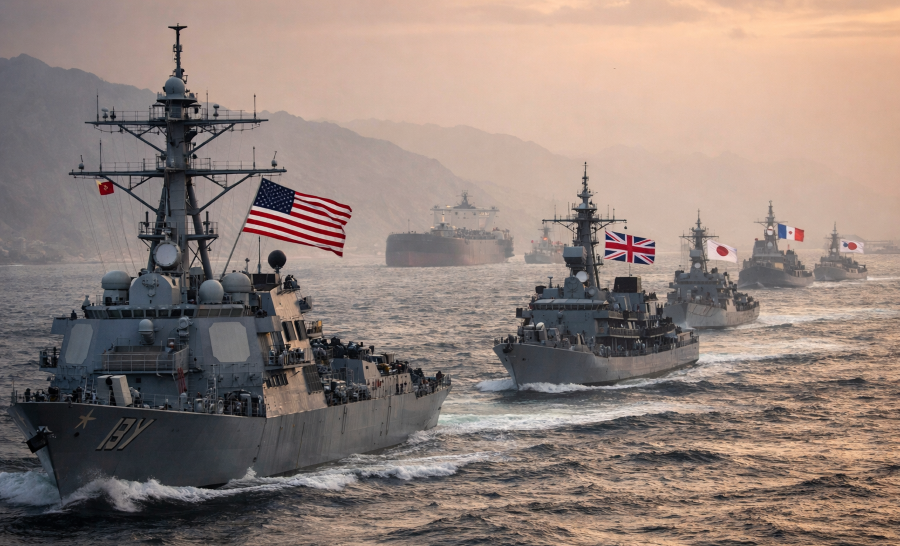
Trump presses allies to deploy warships as Hormuz tensions shake global oil markets
U.S. President Donald Trump says he has urged roughly seven nations to send naval forces to help secure the Strait of Hormuz, a vital shipping route through which about 20 percent of the world’s traded oil typically passes. The appeal comes amid escalating conflict involving Iran and rising global energy prices, though no country has yet committed to joining such a maritime coalition.
Speaking to reporters aboard Air Force One, Trump argued that countries heavily dependent on Middle Eastern oil should take primary responsibility for safeguarding the waterway. He emphasized that the United States receives relatively little crude through the strait compared to other major economies, including China. While expressing hope for international cooperation, he warned that Washington would remember which allies chose to support the effort.
Diplomatic caution and geopolitical friction
Governments across Europe and Asia responded cautiously. British officials confirmed discussions on restoring stable shipping routes, while France indicated it is exploring a possible escort mission but only when hostilities ease. Germany signaled reluctance to become directly involved in the conflict, and South Korea said it would continue monitoring developments in coordination with Washington.
China, meanwhile, called for collective responsibility in ensuring stable energy supplies, emphasizing diplomatic engagement rather than military escalation. Iran’s leadership has maintained that the strait remains open to most global shipping but warned it may target infrastructure linked to the United States or its allies if its own facilities are attacked.
Intensifying regional violence
The broader conflict has expanded across the Middle East, with missile and drone strikes reported in Gulf states and new damage recorded in Israel, Lebanon, and Iran. Civilian casualties continue to mount, and large-scale displacement is worsening humanitarian conditions.
In Iran, international humanitarian organizations report more than 1,300 deaths, including hundreds of women and children. Lebanon’s health authorities say over 800 people have been killed since renewed hostilities intensified, while hundreds of thousands have been forced to flee their homes. Israeli officials, where government have imposed stringent censorship and crackdown, have also reported civilian fatalities and widespread damage from missile attacks.
Oil markets and global economic anxiety
The disruption to energy shipments has driven oil prices sharply upward, prompting the International Energy Agency to announce a record coordinated release of strategic reserves. Nearly 412 million barrels are expected to be injected into global markets in an attempt to stabilize supply and curb price spikes.
Despite the uncertainty, Trump expressed confidence that energy markets would recover quickly once hostilities subside, predicting a rapid decline in oil prices when the conflict ends.
A fragile global balance
As diplomatic negotiations stall and military operations continue, the strategic importance of the Strait of Hormuz has once again underscored the deep interconnection between regional conflicts and global economic stability. Whether a multinational naval coalition materializes, and how Iran responds, may determine the trajectory of both the war and the world’s energy markets in the weeks ahead.
No comments on this post yet. Be the first!